
THE QUICK VERSION
Choose the mounting method first. The right option depends on your window surface and how often you remove the cover.
- Smooth glass + a portable cover: compare suction cups.
- A fitted shade left in place: compare compatible adhesive options.
- Ordinary curtain panels: check the tension rod’s supports and load limit.
Affiliate disclosure: As an Amazon Associate I earn from qualifying purchases.
Open the product comparisons and measuring checklist
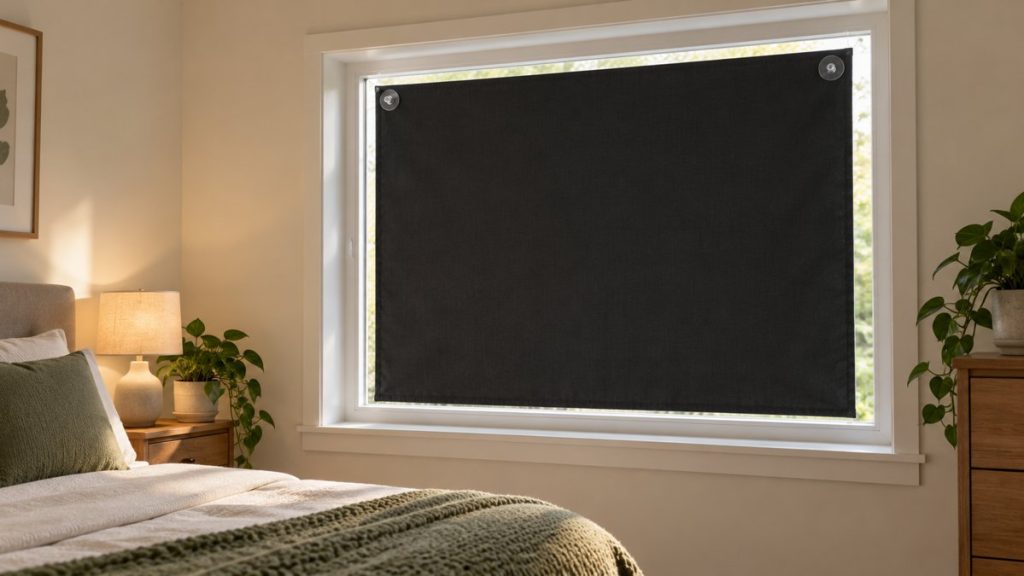
Want a darker bedroom without putting screw holes in the wall? Start with the mounting surface, not the curtain color. A portable cover can attach to suitable glass, an adhesive shade needs a compatible mounting surface, and a tension rod needs supports that match its design.
Quick answer: For a temporary cover on smooth glass, compare suction-cup blackout curtains. For a trim-to-fit shade you plan to leave mounted, compare adhesive blackout shades. If you want ordinary curtain panels, first check whether your window recess can support a suitable tension rod. No drilling does not automatically mean no marks, no residue or a secure fit on every window.
Affiliate disclosure: As an Amazon Associate I earn from qualifying purchases. Links below let you check product options on Amazon; prices, sellers and availability can change.
Which no-drill option fits your window?
| Option | Consider it when | Check before ordering |
|---|---|---|
| Suction-cup curtain | You want a cover you can take down and pack | Usable smooth glass, coverage and access to the window |
| Adhesive blackout shade or sheet | You want a cover sized to a particular window | Approved surface, removal instructions and whether cutting is required |
| Tension rod with curtain panels | You prefer a curtain you can open and close | Support geometry, rod span, total load and panel fit |
These options include both portable covers and shades as alternatives to hanging curtain panels. A shade covers the window directly; a curtain panel hangs from hardware. That difference matters when you need daily access to handles or existing blinds.
Three product examples to compare
The three examples below cover suction-cup and adhesive constructions; the tension-rod section is a separate hardware discussion. We compared designs and sizes described in retrieved product listings, including older copies. We have not tested these products or confirmed current Amazon offers. Check the selected variant and purchase options before buying.
| Retrieved listing | Listed size and quantity | Mounting approach | Purchase tradeoff |
|---|---|---|---|
| Amazon Basics, Moon and Stars | 50 × 78 inches; one cover | Suction cups on smooth glass | Compare usable glass and obstructions with the cover dimensions |
| Redi Shade Original Blackout, black | 36 × 72 inches per shade; six-pack | Trim-to-fit adhesive paper shade | Check whether you need the full pack and how the mounting strip is removed |
| Petaholic blackout sheet | 118 × 57 inches; one sheet | Cut-to-fit cover with stickers and tabs | Plan the cut and attachment points before altering the sheet |
Dimensions and pack counts above come from the retrieved listing copies, not a live stock check. Removal and repeat-use suitability depend on the exact fixing instructions and surface; we have not tested either.
Amazon Basics portable blackout curtain: suction-cup mounting
The linked Moon and Stars, one-pack version is listed at 50 inches wide by 78 inches long. Amazon describes suction cups for smooth glass and tabs for adjusting the cover. Consider this construction when packing and removing the cover matter more than the appearance of a hanging drape. Measure the usable glass and check for handles or other obstructions.
Check the Amazon Basics curtain options on Amazon
Redi Shade Original Blackout paper shade: adhesive mounting
The retrieved Amazon listing describes the black version as a six-pack of 36-by-72-inch pleated paper shades. It is a shade, not a fabric curtain. Its trim-to-fit, adhesive design uses clips to adjust the raised shade. Consider it for a measured window rather than assuming it is a reusable travel cover. Follow the product’s surface-preparation and removal directions. If you only need to cover one window, decide whether a six-pack is useful before choosing this offer.
Check the Redi Shade blackout paper shade on Amazon
Petaholic blackout sheet: cut-to-fit cover with stickers and tabs
The linked Petaholic version is listed as a 118-by-57-inch sheet with adhesive stickers and hook-and-loop tabs. It offers a different sizing approach from the pleated shade. Before cutting, decide how the sheet will cover your window and where each fixing will go. Do not treat the listing’s blackout or residue-free claims as a guarantee for your installation. Cutting commits you to the chosen shape; compare the sheet size with your actual project rather than buying extra material by default.
Check the Petaholic cover options on Amazon
Prefer hanging curtains? Check the hardware first
A tension rod can be worth considering if its intended supports match your room. Do not assume all tension systems work the same way: a rod fitted between the sides of a window recess differs from a floor-to-ceiling system. Neither choice includes a blackout curtain unless the product specifically says so.
For example, Umbra’s Anywhere system uses a different support arrangement from a simple recess rod, and its panels are sold separately. Use the exact system’s instructions for dimensions and load limits. We have not selected an Amazon rod-and-panel combination for this guide.
Before choosing panels, check their header type, finished length, coverage and total weight against the hardware requirements. A blackout fabric label alone does not tell you how much light may enter around the edges of the installed curtain.
How to compare your measurements with the listing
Sketch the opening you need to cover, then mark where the fixings can actually attach. Record the width and height in the same units as the product listing. Compare both dimensions, not just the longest side: a long sheet may still be too narrow in the orientation you need.
Mark handles, locks and existing blinds on the sketch. For a rod, measure between the support points specified by its instructions. Use the exact cover’s measuring directions for edge coverage and any trimming allowance; there is no single extra margin in this guide that applies to all three designs.
A five-minute check before you buy
- Identify the mounting surface. Glass, painted trim and the sides of a recess are different starting points. Use only surfaces allowed by the exact product’s instructions.
- Measure the opening and obstructions. Note width, height, handles, vents and existing blinds. For tension systems, also measure the required support points.
- Decide how often it comes down. Packing a cover for a trip and raising a shade each morning are different tasks.
- Check removal before installation. Read the fixing manufacturer’s directions and your property’s restrictions before using adhesive or pressure-mounted hardware.
- Check the complete purchase. Confirm the variant, quantity, included fixings, seller’s current terms and any separate hardware or panels you still need.
Keep window controls and any emergency opening accessible. Do not improvise an attachment over a heater, vent or damaged surface; follow the product and window manufacturers’ instructions.
When a sleep mask is the simpler alternative
If your goal is to cover your eyes rather than darken the whole room, you may prefer a mask. It will not replace a window covering for room privacy or for someone else sharing the space. Start with our sleep-mask fit guide, or compare sleep-mask designs for side sleepers if pillow contact is your main concern.
Questions worth answering before checkout
Can you put up blackout curtains without a rod?
Some portable covers attach directly to an approved surface with suction cups or adhesive fixings. They are alternatives to a rod-mounted curtain, not interchangeable mounting methods for any curtain panel.
Are no-drill options automatically renter-safe?
No. Check your property’s rules and the exact fixing and surface instructions. The absence of screws does not establish that adhesive removal or pressure from hardware will leave every finish unchanged.
Will a blackout label guarantee a completely dark room?
Do not assume so. Compare the cover’s dimensions and installed edge fit as well as the product’s stated light-blocking properties. This guide does not include room-darkness measurements.
Sources and how we compared these options
Vendixia prepared this documentary comparison from the three linked Amazon listings, Redi Shade’s Original Blackout product information, and Umbra’s linked system description. Redi Shade’s direct-store page describes a four-pack; the Amazon example above is a six-pack. Check the pack you are buying. Sources were reviewed on October 30, 2026; some retrieved listing copies were older. We could not confirm a current featured offer for the three Amazon examples, so no live price, stock, delivery date or return promise is stated. Selection is based on mounting method and fit checks, not hands-on testing or a paid ranking.